I’ll tell you what happened.
I don’t know if I can.
Rachel Kice is a multidisciplinary artist working in painting, writing, performance, and installation. Her work grows out of encounters with environment and lived experience, and explores what we try to keep, what we bury, and how it changes over time.
In Shapes of Earth (2023–), she places canvases directly on the forest floor in the Pike National Forest in Colorado, working in response to the textures beneath them. Some works are buried or left outdoors for extended periods, allowing weather and time to alter the surface before being returned to the studio, where thin layers of paint preserve these marks. Portions of this process are documented in short-form videos, where the work is tracked in real time, often with humor.
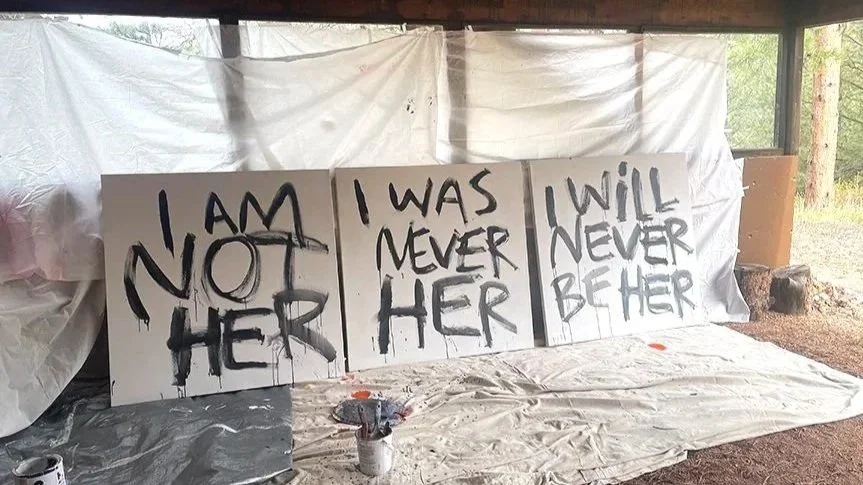
Other works use language as material, abstracting words or breaking a sentence across multiple paintings so meaning emerges through association.
Kice first gained recognition through live painting performances with the MuzikMafia, sharing the stage with artists including Big & Rich and Gretchen Wilson. Her work is held in public and private collections including the Tennessee State Museum, Warner Bros., Sony, Berklee College of Music, and Creative Artists Agency.